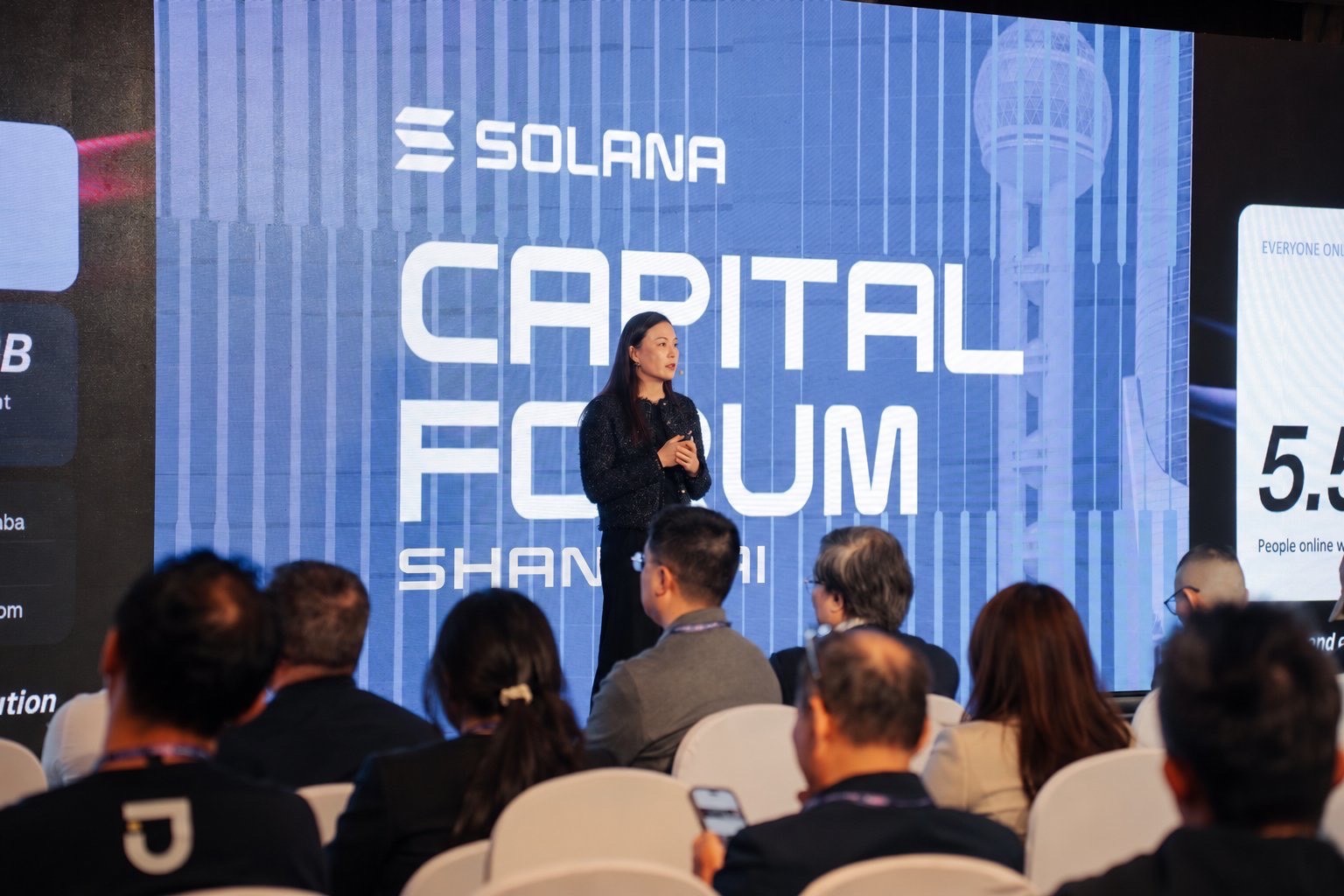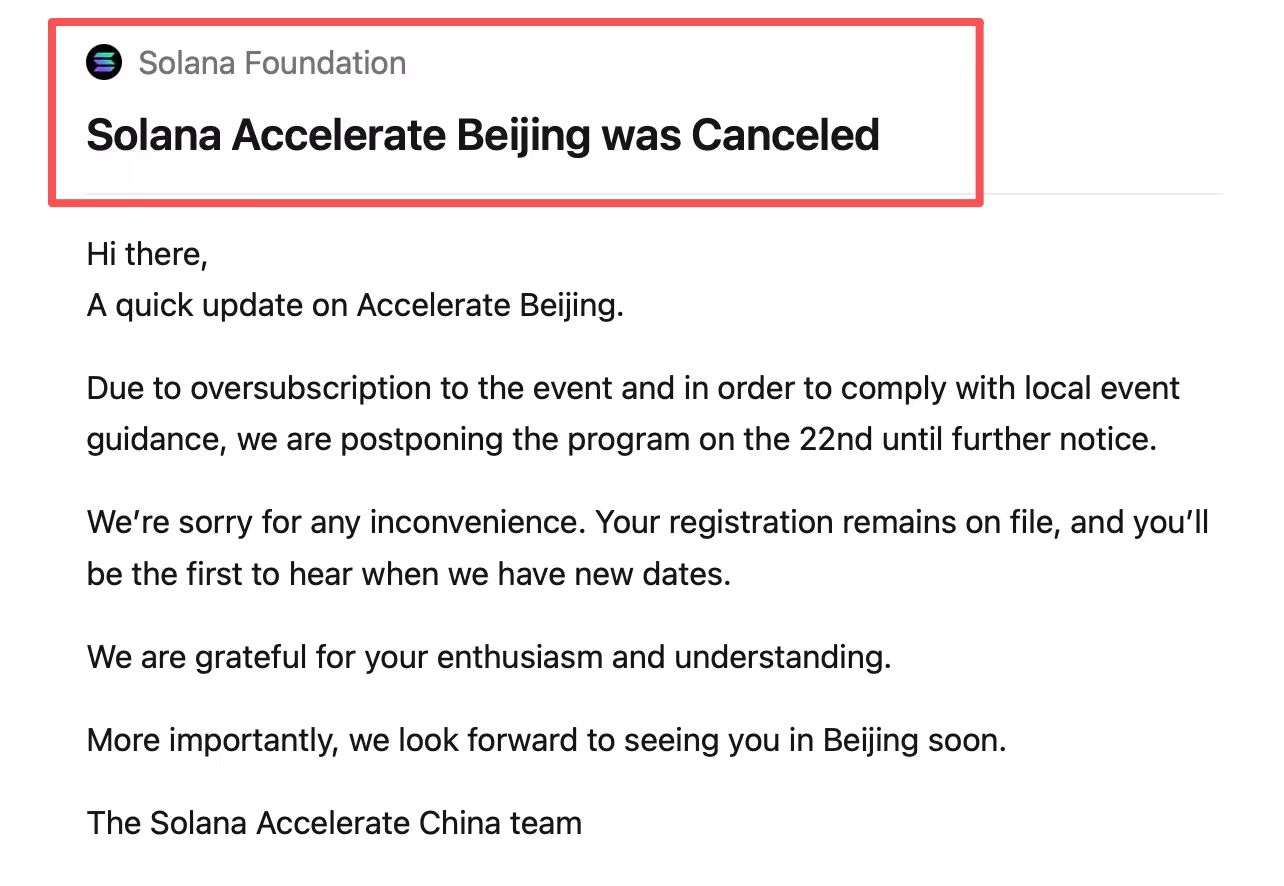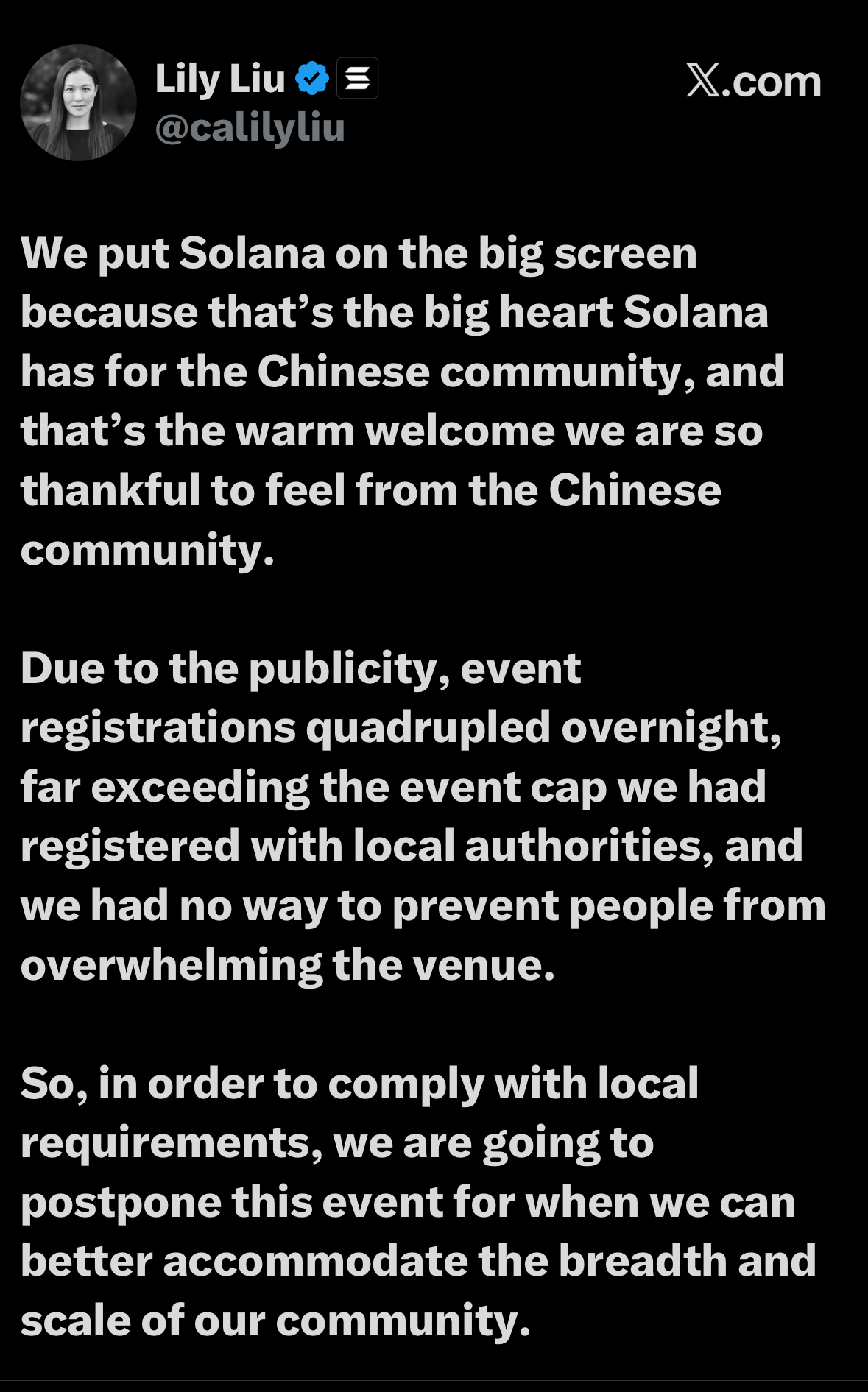
How does the light show pay for itself? Solana’s China business case
Source's factual reference point: 17 October 2026. This industry feature does not constitute investment advice. Its industrial-park analogy draws on analysis by lawyer Liu Honglin in Foresight News; the data treatment and commercial inferences are RWA Space's own.
RWA Space editorial introduction. Industry quotations put the cost of a single evening's large-screen advertising on the Bund at roughly several hundred thousand renminbi. Why would a foundation spend that money in a market as sensitive to cryptocurrency regulation as China? Our previous two features examined Solana's experience in China and the hypotheses it prompted. This article changes the lens. Set sentiment and the regulatory debate aside for a moment and examine the economics: what business is being pursued, who pays, who earns, and whether that model can operate within the boundaries described in the source.
1. A different starting point: the target is not simply token buyers
A public-blockchain brand often prompts an immediate thought about its token price. But lay out Solana's activities over the preceding fortnight—an office, a four-city tour and a capital summit—and the commentary's argument becomes clearer: people buying tokens appear to be among the least important audiences it was trying to reach.
Lawyer Liu Honglin offered a useful analogy in Foresight News: a public-blockchain ecosystem resembles an industrial park. A park builds roads, holds events and offers subsidies to attract businesses. A blockchain ecosystem supplies development tools, technical support and grants to attract teams building products on its network. Their legal character is fundamentally different; the recruitment logic is comparable.
In that interpretation, the Bund light show was less a declaration or a provocation than a conventional customer-acquisition expense—the equivalent of an industrial park putting a billboard beside a motorway. Its value depends less on the appearance of the display than on the businesses that subsequently choose to build there.
2. Who earns in the ecosystem? SOL as a toll, rather than a share
The economics need to be separated because saying “the blockchain makes money” is too imprecise.
Application companies earn revenue from their products and services. Validators maintaining the network receive rewards under its rules. The foundation is a spender, supporting developers in pursuit of a more active ecosystem. Transactions on the network require SOL to pay fees, so increased usage can support demand for SOL. Usage, the revenues earned by different participants and the token price nevertheless do not move in a one-to-one relationship. Within the industrial-park analogy, SOL is closer to a toll or a utility payment than equity in the park. On this reading, asking whether Solana's arrival in China signals a token-price rally points in the wrong direction: building relationships and infrastructure does not establish a direct causal link to secondary-market prices.
This is the source's explanation for substantial spending in a market that restricts cryptocurrency speculation. The foundation is buying the probability that the next cohort of strong products chooses its network, rather than simply buying trading volume.
3. Which businesses is the ecosystem trying to attract?
Industrial parks also face a strategic choice: are they recruiting individual tenants, or building an industry?
According to the public information cited in the source, the Solana Foundation's grant programme disburses funding against milestones, and applicants must explain how their projects benefit the network. This is the tenant-recruitment model: teams develop products, and the network becomes more active.
The source interprets the closed capital summit on 15 October as evidence of a broader ambition. In its reading, Liu's three subsequent “learnings” form an asset-side list: companies said to trade at one-sixth of New York peers' valuations at comparable earnings, 50,000 small and medium-sized enterprises said to be waiting for IPO opportunities, and life-sciences IP described as holding a leading global share. The hundreds of participants described as allocators represent the capital side of that proposed equation: global money. These descriptions and figures are retained as claims from the supplied commentary, rather than independently established measurements.
Putting those sides together produces the business thesis. One side is assets the source characterises as undervalued in China; the other is global capital seeking assets. Solana would seek to be the industrial park connecting them, earning tolls rather than selling factory buildings. In the source's model, assets would have their rights recorded, be priced and be transferred on its network, with fees arising at each step. The article casts this as an opportunity an order of magnitude larger than developer recruitment alone. It also offers an explanation for pursuing the market despite the risk of events being halted: the listing ambitions of 50,000 businesses and a claimed one-sixth valuation would be difficult for a capital-markets infrastructure provider to ignore. This is the source's commercial hypothesis, not evidence that those activities have already been delivered or authorised.
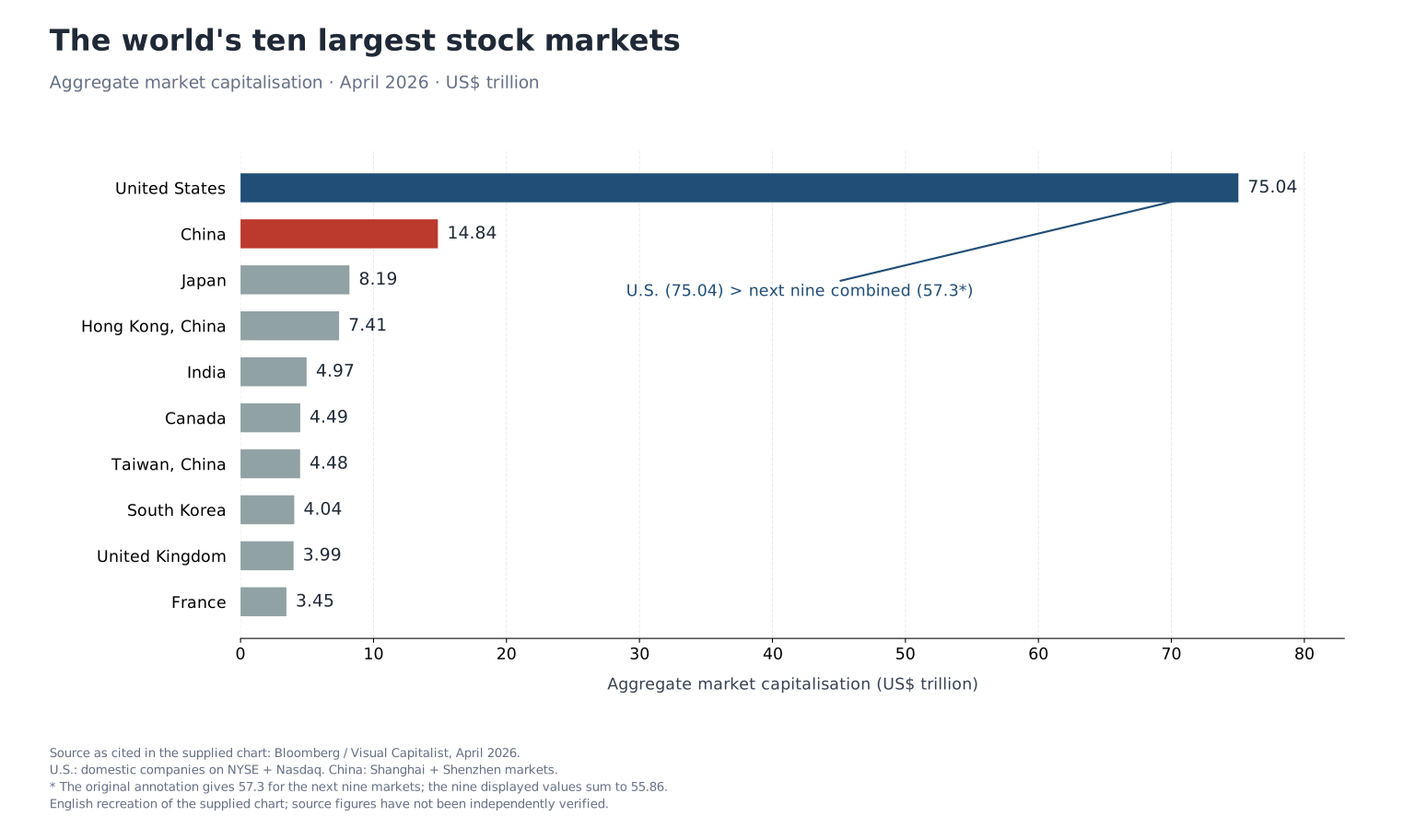
Aggregate market capitalisation · April 2026 · US$ trillion
United States: 75.04; China: 14.84; Japan: 8.19; Hong Kong, China: 7.41; India: 4.97; Canada: 4.49; Taiwan, China: 4.48; South Korea: 4.04; United Kingdom: 3.99; France: 3.45.
Original annotation: United States (75.04) > next nine markets combined (57.3). The original annotation gives 57.3 for the next nine markets; the nine displayed values sum to 55.86.
Source as cited in the supplied chart: Bloomberg / Visual Capitalist, April 2026. U.S.: domestic companies on NYSE + Nasdaq. China: Shanghai + Shenzhen markets.
English recreation of the supplied chart; source figures have not been independently verified.
The world's ten largest stock markets by aggregate market capitalisation
Figure: aggregate market capitalisation of the world's ten largest stock markets. Source attribution in the original: Bloomberg data, compiled by Visual Capitalist, April 2026.
4. Can that model operate within the stated boundaries?
Even if the commercial logic is coherent, the remaining questions concern its boundaries. The source frames them as two separate lines.
The first distinguishes the movement of technology from financial business. The source cites guidance from the Ministry of Industry and Information Technology and the Cyberspace Administration of China supporting blockchain R&D and industrial applications, while describing the cited No. 42 circular as prohibiting financial activities such as fiat-to-virtual-currency exchange and token-based fundraising. Explaining architecture and demonstrating tools to developers can have a legitimate operating space; encouraging token purchases or promising returns changes the nature of the activity. The source reads the contrasting Shanghai events over that fortnight—a public conference halted amid publicity and a closed summit reportedly completed—as an illustration of that distinction. Its interpretation is that the relevant questions are who is being addressed, at what scale, and towards what activity, rather than the blockchain alone. That interpretation does not establish the authorities' reasons for the different outcomes.
The second concerns Chinese teams building in China for global markets. Three questions must be answered first: what does the product do, which market does it enter, and whom does it serve? Selling onchain data analytics to overseas businesses by subscription principally raises data and contractual questions. Offering token exchange, asset custody or yield services adds financial-regulatory and licensing requirements. The technology stack can be identical while the regulatory burden differs substantially. One further distinction is essential: overseas incorporation and a foreign-law contract do not remove restrictions on providing services to mainland users. A business plan's statement of intended customers is insufficient; the product and its operations must implement the relevant restrictions on mainland access.
The practical checklist for builders appeared in our previous article. Here the commercial interpretation adds one point: compliance costs can function as a moat, rather than merely as an obstacle. In the source's thesis, teams capable of sustaining those costs are precisely the businesses Solana and the allocators would most want to recruit.
5. What the accounts ultimately have to show
Solana's proposed China strategy is ultimately a wager on time. Branding expenditure comes first—the light show and the office—followed by operating expenditure on events and grants. The wager is that, over the following years, Chinese teams will build products on the network for global customers and Chinese assets will gain access to global pricing through that infrastructure. Every step takes time, and changes in the regulatory environment can alter every step.
The test is what follows the display: whether Chinese teams actually use this route to sell products overseas and gain recurring paying customers, and whether assets actually achieve global pricing through it. An industrial park does not fail because its billboard is insufficiently bright. It fails because it recruited the wrong businesses.
We will continue to follow the next page of the ledger.
Produced by RWA Space. The source's factual account draws on public reporting and official statements. The industrial-park framework draws on lawyer Liu Honglin's Foresight News article, “What Business Does Solana Want to Do in Shanghai?”, with acknowledgement. Do not use this commentary as a basis for decisions.
Complete professional English adaptation of the supplied RWA Space commentary. Its reference point of 17 October 2026 is an as-of date, not a verified original publication date; no mapping to the separately supplied WeChat URLs is inferred. The advertising-cost estimate, summit account, claimed one-sixth comparable-company valuation, 50,000-business IPO figure, grant arrangements and regulatory descriptions are retained with attribution to the source and have not been independently verified here. The source’s market-capitalisation illustration and comparable-company pricing claim measure different things; neither is presented as independent validation of the other. No figures have been silently recalculated. Statements about fees at each stage express the source’s proposed infrastructure business model and do not establish that all fees accrue to the foundation, that tokenholders own the business, or that these services already operate. Interpretations of event outcomes do not establish regulatory motives or business authorisation. The legal discussion describes the source’s reading of the cited guidance and No. 42 circular, rather than independently verified current law. The chart credit preserves the attribution in the source; its numbers and reuse permissions have not been separately checked. This is historical commentary, not legal or investment advice. The stock-market chart is recreated with English labels and the same figures; its source attribution is retained and the Chinese original remains unchanged.