The bold move first: the summit held before Shanghai’s public event was postponed
Source's factual reference point: the evening of 17 October 2026. This industry feature separates reported information from hypotheses. The speculative passages are for discussion and do not constitute investment advice. External figures are attributed to the source's stated reporting basis; figures not independently checked are identified as being reported in public sources.
RWA Space editorial introduction. In our earlier feature, Four Cities on Hold, we proposed a hypothesis: the source's account of Solana events clearing notifications and approvals across several departments suggested that mainland China's boundary around public blockchains might be more complicated than a blanket prohibition. The speed at which publicity spread might have been part of the issue. Lily Liu's summit recap, published yesterday in the original article's timeline, offered another observation to test that hypothesis: a Capital Markets Summit attended by hundreds of people had already taken place the day before the public event failed to open. This article does three things: tests the distance between the hypothesis and the reported facts, examines three figures or themes Liu disclosed, and develops a deliberately ambitious hypothesis about life sciences. It closes with a checklist of the boundaries described in the current framework cited by the source. One distinction must be clear from the outset: an event taking place does not establish regulatory permission for a financial business. We return to that distinction throughout.
1. Completing the timeline: what else happened that week?
Start with the sequence of events, paying particular attention to 15 October:
- 14 October: the Lujiazui light display, the unveiling of an office and the announcement of a four-city tour.
- Thursday, 15 October: the Solana Capital Markets Summit took place in Shanghai. Liu subsequently described “hundreds of allocators and builders from China and around the world” discussing innovative capital formation. Attendance was reportedly 300-plus; registrations and actual attendance are different measures.
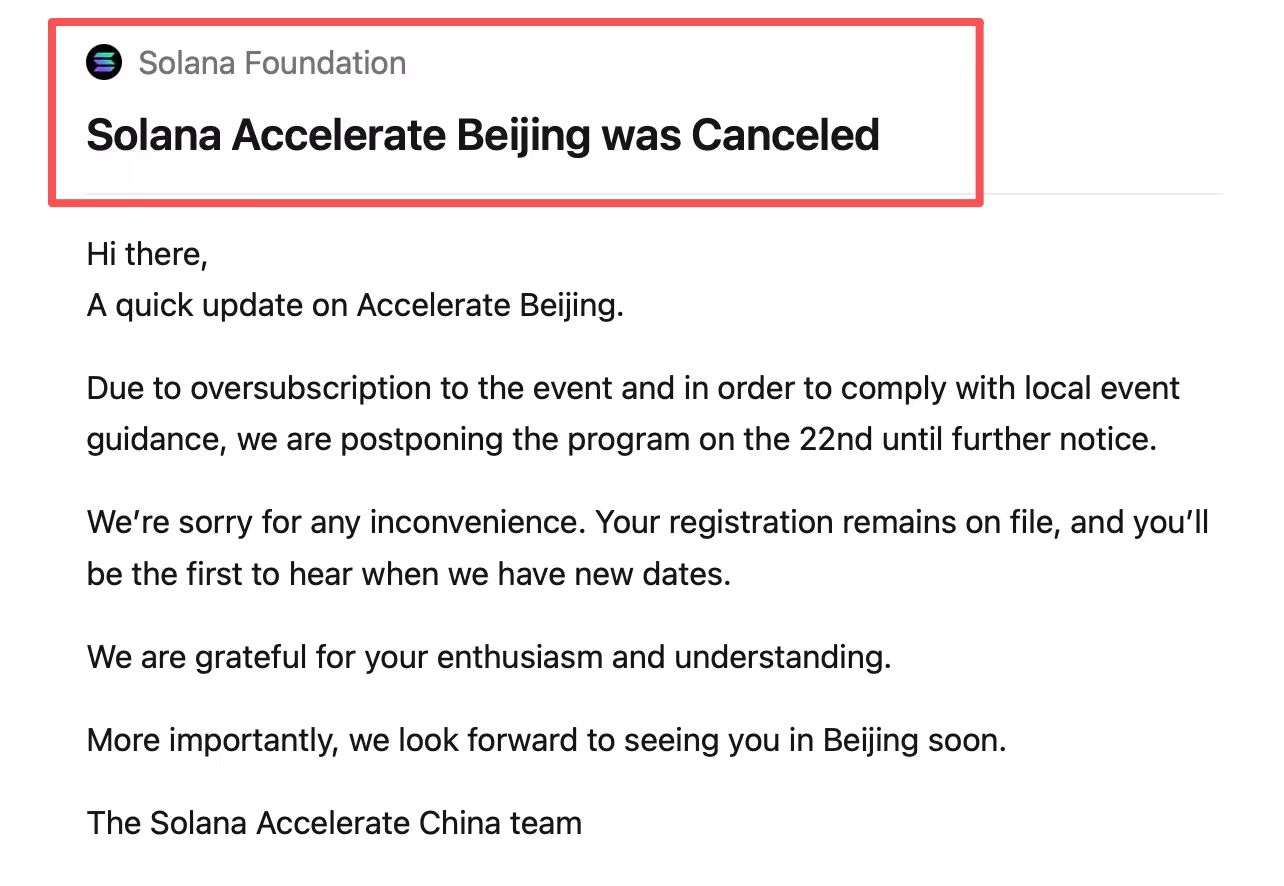
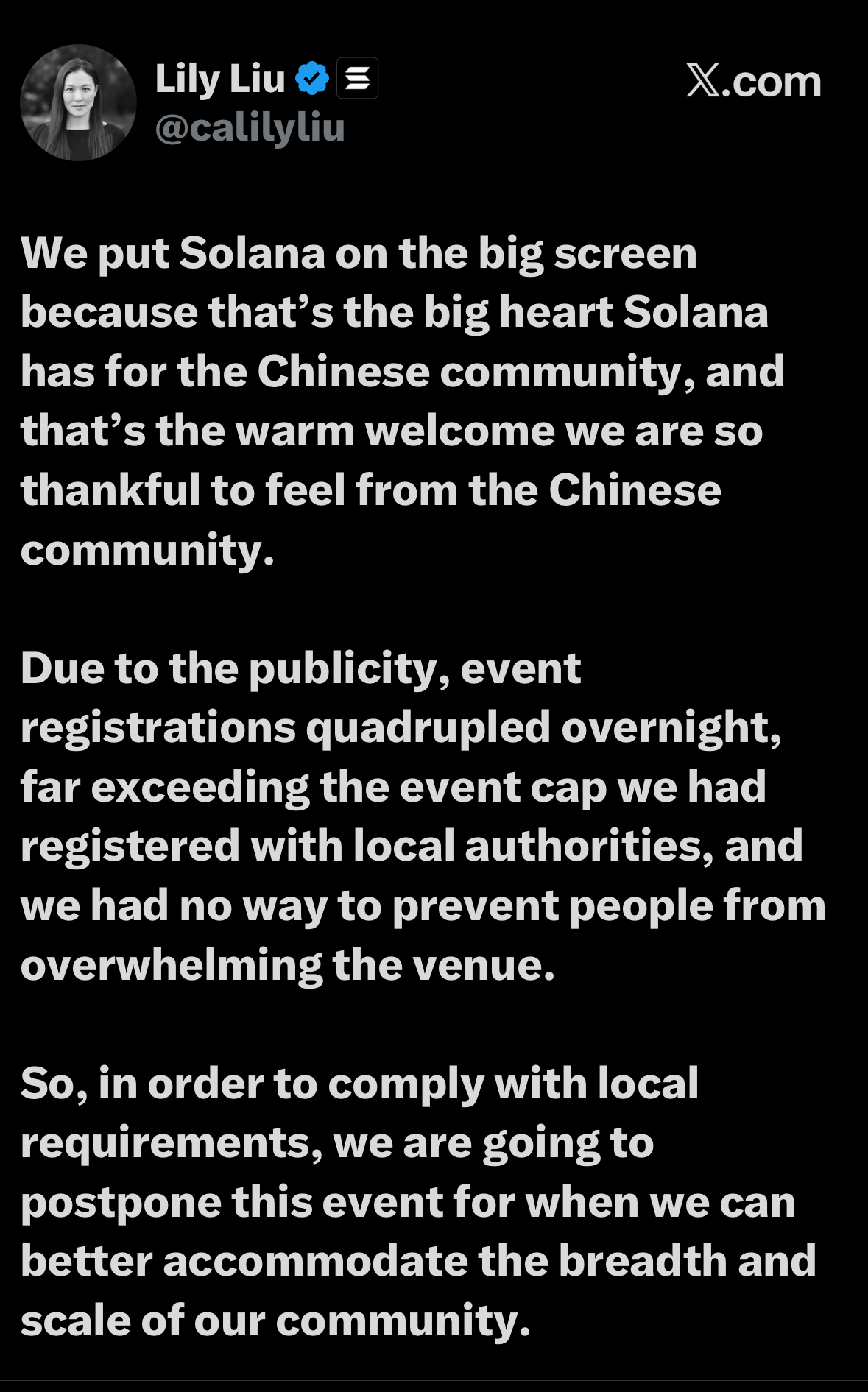
- 16 October: the public Accelerate Shanghai event did not open as scheduled. An email from the organiser attributed the postponement to “venue arrangements.” Some participants also described law-enforcement personnel at the venue; neither the organiser nor an official source had confirmed that account. Liu later said registrations had quadrupled overnight, far exceeding the attendance limit notified to local authorities, and that the event had been postponed to comply with local requirements. On the rest of the four-city tour, Hangzhou and Shenzhen announced postponements, with new dates to follow. The Beijing email used “postponing until further notice.”
- The evening of 17 October: Liu posted her summit recap on X. The official @solana account also stated that the series had visited Silicon Valley, Singapore and Shanghai over the preceding month; its wording was “capital forums.”
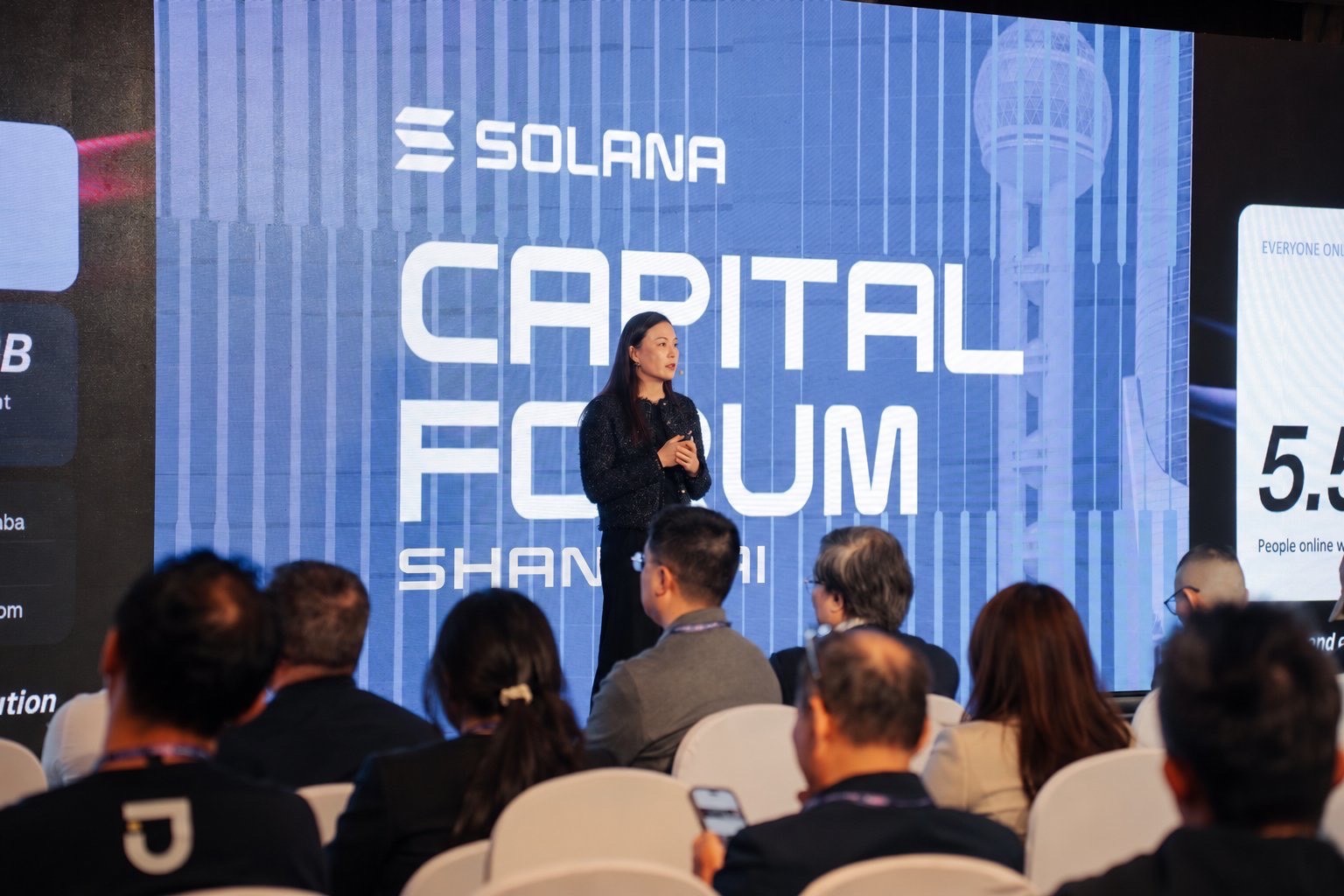
The Shanghai Capital Markets Summit
Figure: Lily Liu at the Shanghai Capital Markets Summit. Source attribution in the original: Solana official materials.
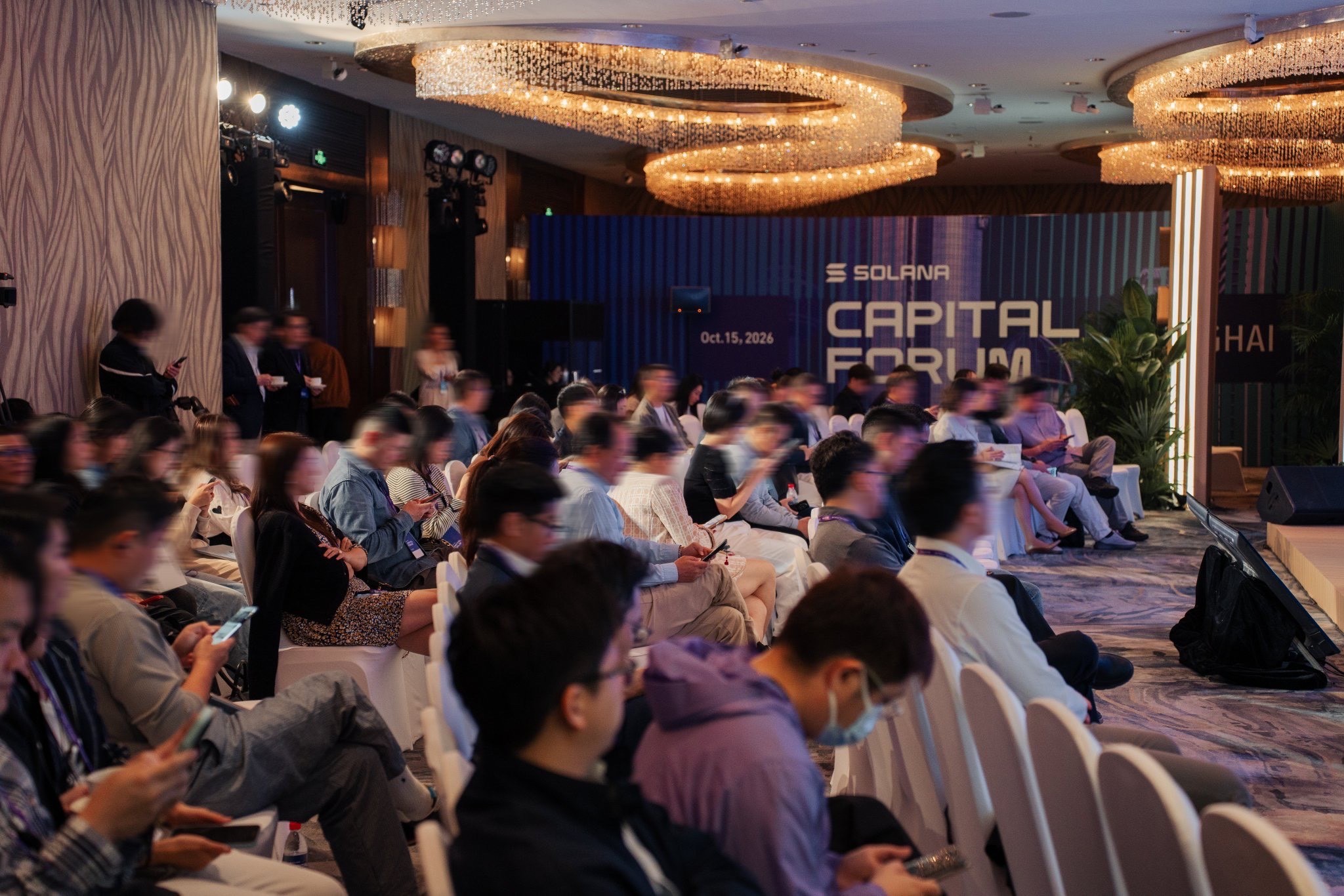
The Capital Markets Summit venue
Figure: the venue of the Shanghai Capital Markets Summit. Source attribution in the original: Solana official materials.
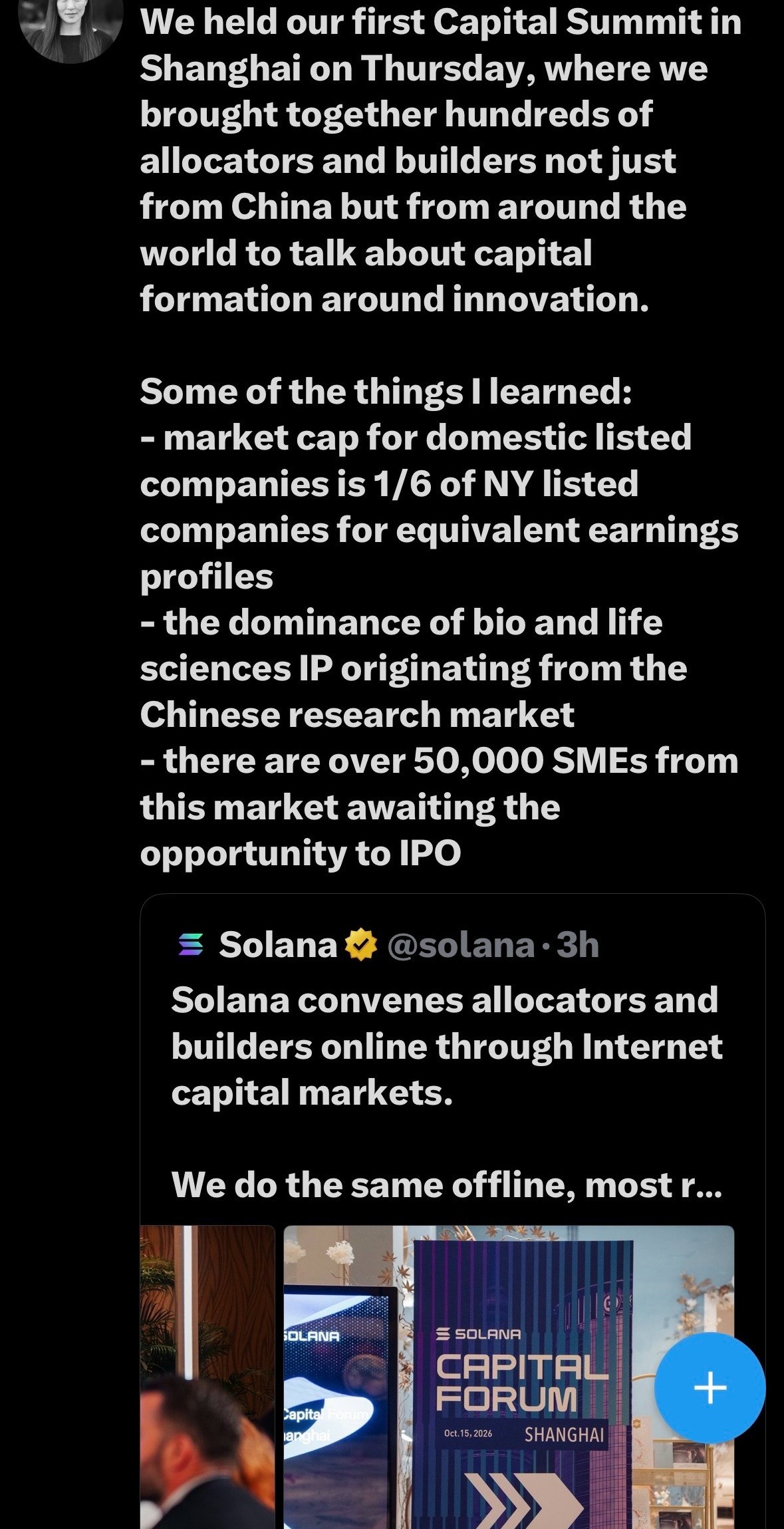
We held our first Capital Summit in Shanghai on Thursday, where we brought together hundreds of allocators and builders not just from China but from around the world to talk about capital formation around innovation. Some of the things I learned: - market cap for domestic listed companies is 1/6 of NY listed companies for equivalent earnings profiles - the dominance of bio and life sciences IP originating from the Chinese research market - there are over 50,000 SMEs from this market awaiting the opportunity to IPO [Embedded post] Solana @solana · 3h Solana convenes allocators and builders online through Internet capital markets. We do the same offline, most r...
The embedded post is visibly truncated. Missing text has not been reconstructed.
Lily Liu's summit recap
Figure: Liu's Capital Markets Summit recap on X. Source attribution in the original: X, @calilyliu.
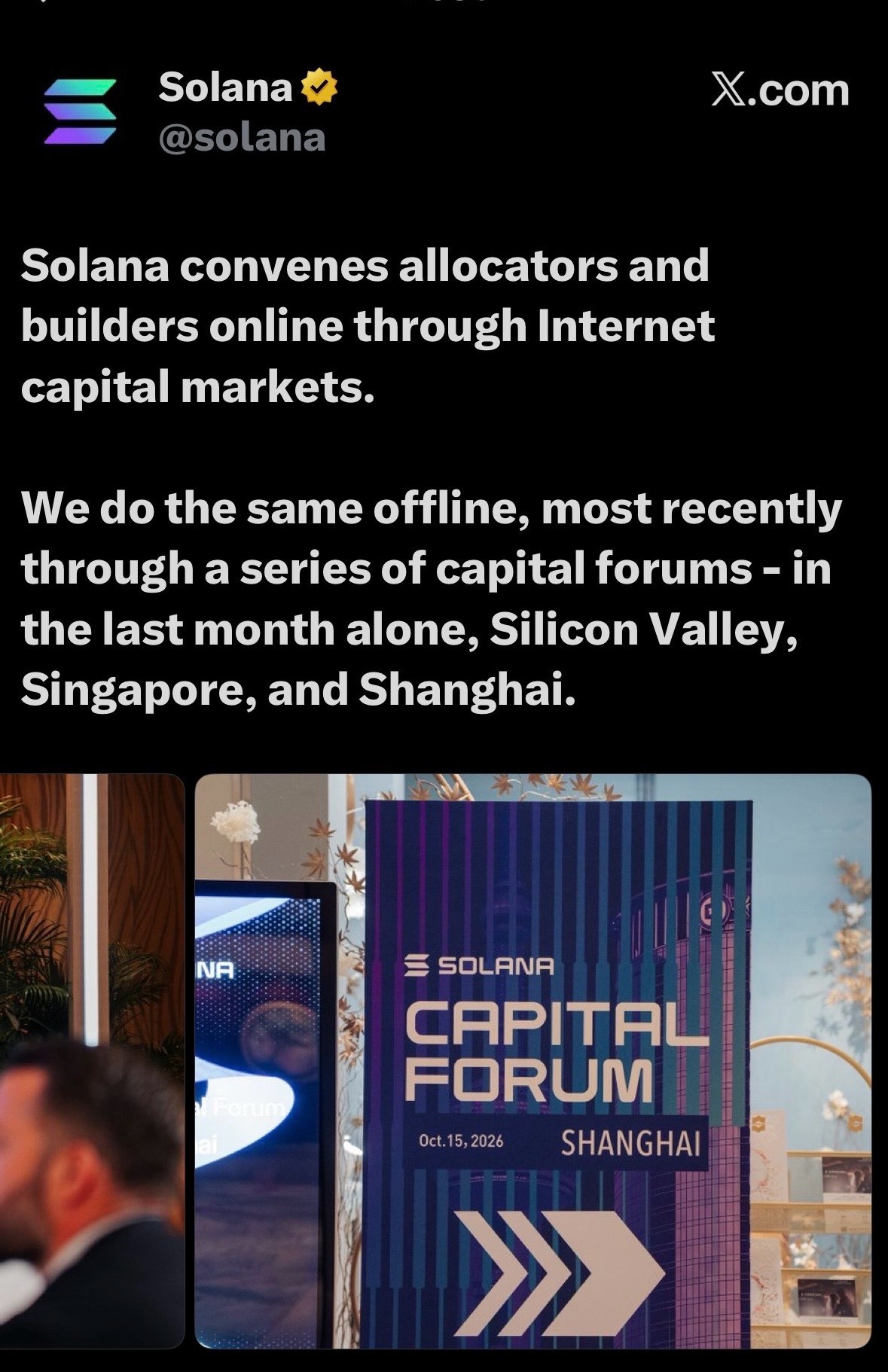
Solana @solana X.com Solana convenes allocators and builders online through Internet capital markets. We do the same offline, most recently through a series of capital forums - in the last month alone, Silicon Valley, Singapore, and Shanghai.
The pictured sign also reads SOLANA / CAPITAL FORUM / Oct.15, 2026 / SHANGHAI.
Solana's official capital-forums post
Figure: the official @solana account identifies Shanghai as a stop in the capital-forums series. Source attribution in the original: X, @solana.
The same week, the same city, the same foundation: two events, one reportedly held on schedule and the other unable to open. What was different? One was a public conference with open registration and substantial media attention; the other was a closed summit with named invitations and no public admission. Timing, the invitation model and the size of the events are hypotheses to investigate, rather than established explanations. The reporting cited in the source says the capital-markets summit took place. That does not establish permission for related issuance, trading or cross-border business. Not being stopped is not the same as being authorised.
2. Three figures and themes from Lily Liu
Liu ended her post with three “learnings.” Comparing them with our earlier feature reveals some common lines of enquiry:
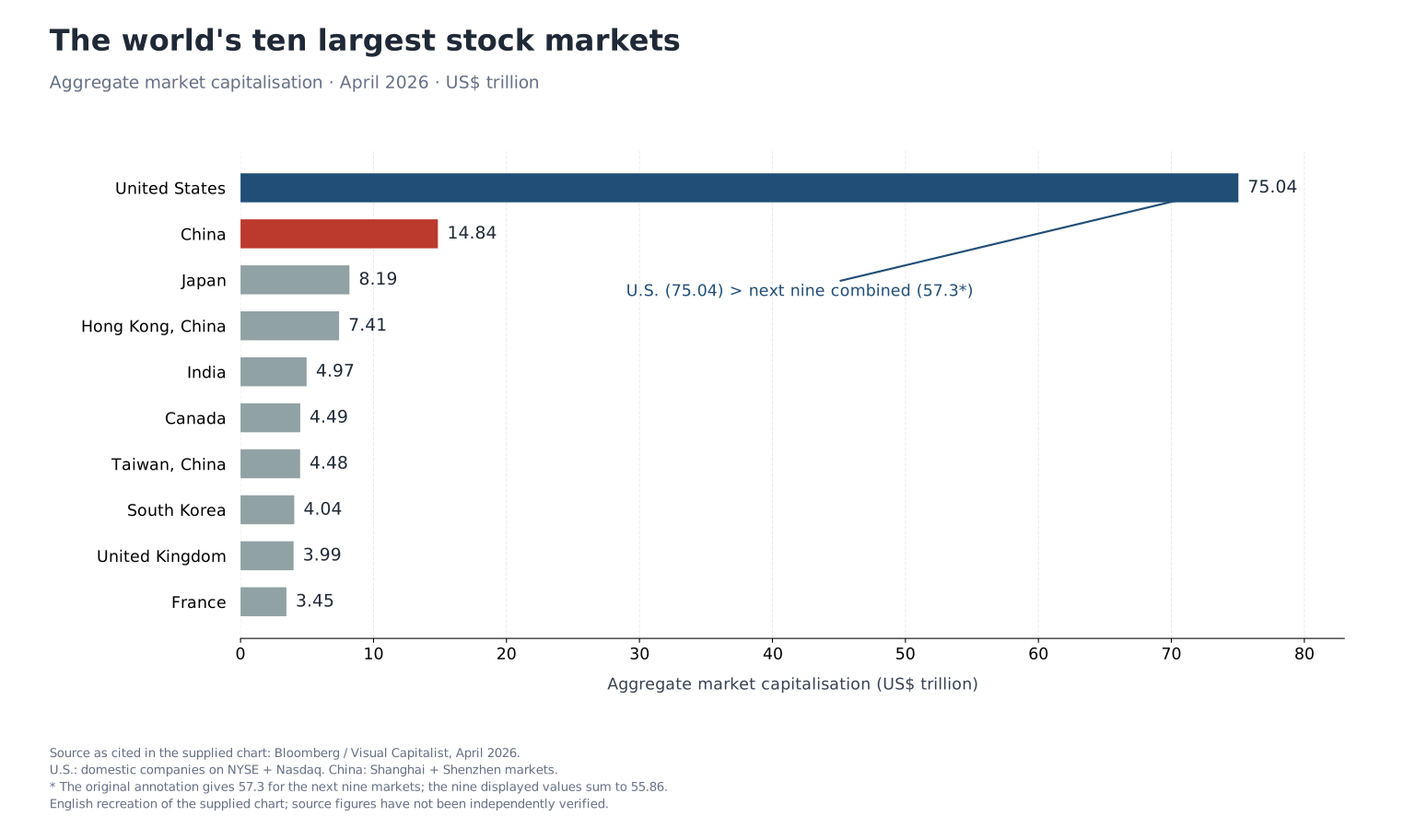
First: companies listed in mainland China were said to be valued at roughly one-sixth of New York companies with comparable earnings. Our previous article had used a different measure: aggregate listed-equity market capitalisation of approximately US$75.04 trillion in the United States and US$14.84 trillion in China, or about one-fifth, citing Bloomberg figures for April 2026. These are different analytical levels. The one-fifth figure primarily reflects scale, including the size of the economy and the coverage of listed companies; the one-sixth claim concerns pricing. As another broad approximation, the source cites publicly reported aggregate price-to-earnings ratios of about 17–18 times for A-shares and about 30 times for US equities, and describes them as broadly consistent in magnitude with that comparable-company discount. Even so, differences in aggregate market capitalisation and discounts between comparable companies do not directly validate one another. Nor do they jointly prove that access to financing is the only constraint. A more specific conclusion requires data measured on a consistent basis.
Second: “more than 50,000 small and medium-sized enterprises are waiting for an IPO opportunity.” We have not independently verified the statistical source, eligibility criteria or geographic coverage of that figure; it is presented on the basis used in the post. More fundamentally, wanting a listing is not the same as entering a formal review process. A discussion of financing demand must distinguish intention, eligibility and an actual filing. “Waiting,” as applied to those 50,000 businesses, describes an aspiration. It is not a verified measure of an unmet supply-and-demand gap, and it does not establish that any public blockchain can serve that demand.
Third: biotechnology and life-sciences intellectual property led by Chinese research. This was a variable our earlier hypothesis had not covered. We had focused on capital and engineers, without anticipating that life sciences would be singled out. We examine that possibility below.
Interim conclusion: our inference and the subjects in the cited disclosures point in similar directions: asset pricing, capital formation and life sciences. That is an overlap in themes, not validation of the figures. Whether Solana has developed the capacity to serve those businesses must be established through specific partnerships, products or issuance documents. At the source article's reference point, none had been presented.
3. An ambitious hypothesis: life sciences × AI × onchain capital
This section is explicitly speculative. The supporting observations come first, followed by the hypothesis. Please read them as separate categories.
Observation one: outbound licensing in Chinese life sciences is active. According to the public reporting cited by the source, recent examples included a licensing agreement between Hengrui Pharma and Novo Nordisk with a potential total value of up to US$2.6 billion, and AstraZeneca taking a strategic equity stake in Summit while advancing joint clinical development. Industry commentary calls this cycle “going global 2.0”: moving beyond selling development programmes towards retaining economic interests, participating in global multicentre trials and forming joint ventures with multinational pharmaceutical companies. Assessing this activity requires more than headline contract values. Upfront payments, realised milestones and subsequent sales matter; an agreement's maximum value is not revenue already received. For the ESMO congress scheduled for 23–27 October, industry-media counts cited in the source identified 28 studies led by Chinese researchers as Late-Breaking Abstracts, including four selected for a Presidential Symposium. LBA is an abstract category at the congress, not a certification of a “breakthrough.” The official congress list is the relevant reference. These examples illustrate licensing and conventional capital channels in operation. Demonstrating that tokenisation improves financing or pricing would require a separate set of specific transaction evidence.
Observation two: research capacity drives the activity; monetisation channels are the proposed bottleneck. The source argues that China's output of life-sciences papers and patents is in the world's leading tier, with substantial advantages in the speed and cost of clinical enrolment. In that analysis, the central constraint is not whether valuable assets exist, but how efficiently they can obtain global pricing and an exit.
The hypothesis: if “Chinese manufacturing × global e-commerce” reshaped the circulation of goods over the past decade, a cross-disciplinary combination worth watching next could be “Chinese life-sciences IP × AI-accelerated R&D × onchain capital formation.” The argument has three parts. AI could further compress development timelines and change the cost curve; the source views structural biology since AlphaFold as evidence of that direction. China could provide the asset pool. Onchain capital markets could offer a second route to pricing and liquidity alongside conventional IPOs. Several activities must nevertheless remain distinct: recording evidence onchain, establishing legal ownership, arranging contractual revenue rights and issuing a tradable token are not the same thing. Whether an onchain record supports rights that can be financed or transferred depends on the transaction structure and its legal effect. Mainland rights and cross-border issuance also require an item-by-item assessment of the applicable rules. Liu's decision to place life-sciences IP alongside the “50,000 businesses awaiting a listing” suggests, at a minimum, that asset-side questions were on her agenda. Whether Solana has built a business around them returns us to the same boundary: without specific documentation, we do not claim a conclusion.
Limits of the hypothesis: every link in this chain involves significant regulatory, technical and ethical uncertainty. The ESMO results may fall short of expectations, and tokenised securities still involve unresolved questions across the world's major markets. A hypothesis can identify a direction to investigate; it cannot promise an outcome.
4. A boundary checklist for builders: which doors are open?
Our earlier feature described a door opening a little. Readers asked what could pass through that opening. The following is the source's synthesis of policy texts—the blockchain-industry guidance attributed to the Ministry of Industry and Information Technology and the Cyberspace Administration of China, and the “No. 42 circular” attributed to the People's Bank of China and seven other authorities—together with observations from these events. Two principles come first: technical exchange and financial business must be assessed separately; legal treatment cannot be inferred from labels such as “onchain” or “RWA,” but must be checked against the actual business structure.
Start with the shape of a possible opportunity. For mainland builders, “develop in China, serve global markets” is a direction to evaluate seriously: using public-blockchain technology to build products for overseas users. Three questions should guide the assessment: what does the product do, which market does it enter, and whom does it serve? Consider two examples. A team selling an onchain data-analytics tool to overseas businesses on a software subscription principally faces the ordinary requirements surrounding data and contracts. A team offering token exchange, asset custody or yield products faces an additional layer of financial regulation and licensing from launch, even if the technology stack is identical. The technical choice may be the same; the nature of the business and its regulatory burden are different.
Those questions must also be translated into operational decisions before launch. Naming target customers in a business plan is insufficient. Product and operations need to implement that scope: how users are admitted, which features are restricted in which jurisdictions, whom Chinese-language marketing addresses, and whether a mainland team solicits trading customers. Overseas incorporation and a contract governed by foreign law do not remove restrictions on providing services into mainland China.
Activities the source identifies as having a policy-supported route, subject to the stated boundaries:
- Closed technical exchanges and developer relations: discussions of architecture, tools and deployment can have a legitimate operating space. The Capital Markets Summit concerned capital formation, however, rather than technical exchange, and cannot serve as evidence for the treatment of a technical event. Its proximity to financial activity makes additional caution necessary.
- Software development for global markets: researching open-source code, developing software and earning subscription or service revenue from overseas clients can be assessed using the three questions above.
- Ecosystem grants and milestone-based funding: the Solana Foundation's grant programme operates publicly and Chinese teams can apply, according to the source. If a grant is paid in the onchain asset SOL, receipt and conversion by a mainland team raise separate questions under the restrictions on exchange and require their own assessment.
- Industrial blockchain applications: supply-chain traceability, data-rights attribution and evidentiary records are described as consistent with the direction of national blockchain-network development.
- Licensed financial routes: the source identifies Hong Kong's licensed framework, including institutions such as OSL, as a route for relevant RWA, stablecoin and ETF activities. A Hong Kong licence covers its Hong Kong jurisdictional scope; it does not authorise the same business in mainland China. The source also reads Article 14 of the cited No. 42 circular as requiring approval or filing on the mainland side where the underlying assets are in the mainland, even if issuance and trading occur in Hong Kong.
Red lines as summarised by the source from the cited No. 42 circular—not verbatim quotations:
- Fiat-to-virtual-currency exchange business and related services.
- Token-based fundraising in mainland China. The source also describes restrictions on overseas issuance: under its summary of Article 13, mainland entities and overseas entities they control may not issue virtual currencies overseas without the competent authorities' approval.
- Overseas RWA tokenisation based on mainland rights or interests, for which the source's summary of Article 14 requires approval or filing by the competent authorities. The source says the restrictions extend to the activity itself and to institutions supplying intermediary or technical services for it, rather than only to promotional activity.
- Promoting trading platforms to mainland residents, soliciting speculative cryptocurrency trading or promising returns from holding tokens.
- Using expressions such as “RWA” or “stablecoin” in an enterprise name or registered business scope, as described in the source's summary of Article 8.
An observation to investigate, raised by these events:
Publicity. The sequence of notification, excess registrations and postponement, on the organiser's account, suggests that an event's scale and the intensity of its publicity may themselves matter, even when its subject matter is unchanged. A smaller closed gathering reportedly took place; the public conference was postponed. The practical inference the source offers builders is to manage publicity if they want to sustain a presence. This is an observation to test, not an established conclusion.
5. A final thought
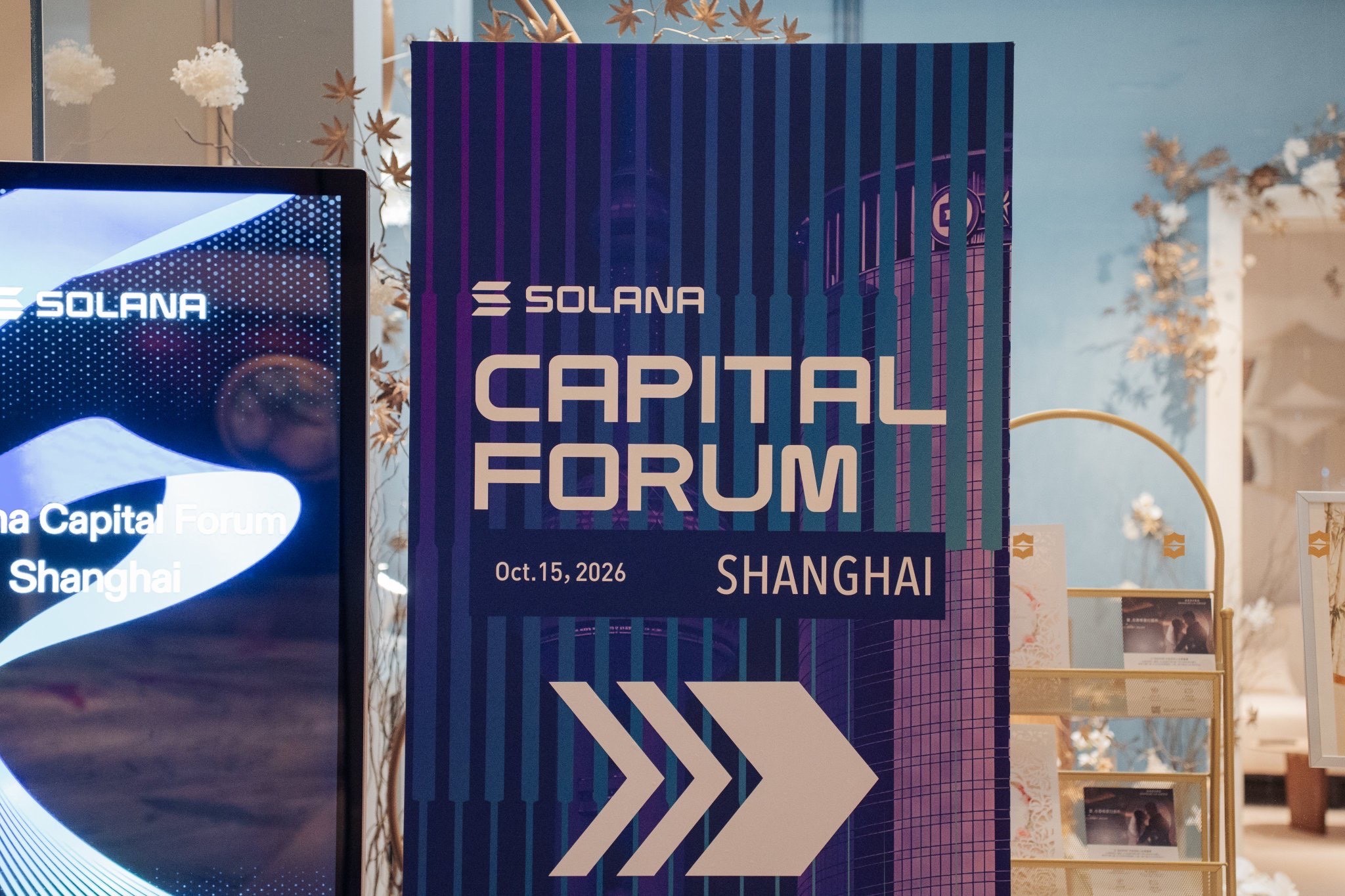
The Shanghai Capital Markets Summit
Figure: the Shanghai Capital Markets Summit, 15 October 2026. Source attribution in the original: Solana official materials.
Our previous article ended with the image of a door opening a little. At that point, we did not know what was behind it.
The source's updated account places hundreds of allocators and builders behind that door, discussing asset pricing, capital formation and life sciences—subjects that partly overlapped with our earlier hypothesis. The day before the public event was postponed, the closed discussion had reportedly proceeded.
The bold get to experience the world first. This example suggests a necessary addition: they must also understand the boundaries. Those boundaries are less a fixed wall than a curve being tested repeatedly. The advantage belongs to those who read that curve most accurately.
Produced by RWA Space. The source's factual account draws on public X posts by @calilyliu and @solana and reporting including Foresight News, 21st Century Business Herald's online coverage and China Economic Net. The pharmaceutical-transaction figures and IPO-related statistics have not been independently verified and are presented as reported in public sources. Speculative passages are explicitly identified. Do not use this commentary as a basis for decisions.
Complete professional English adaptation of the supplied RWA Space commentary, retaining its argument, historical figures, quotations, captions, speculative passages and legal-boundary checklist. The source’s reference point of the evening of 17 October 2026 is an as-of date, not a verified publication date. The publication date displayed separately was supplied by the site owner; mapping to the separately supplied WeChat URLs remains pending. The underlying X posts, attendance accounts, pharmaceutical transactions, IPO statistics, event explanations and cited No. 42 circular—including its article-by-article legal summary—have not been independently verified for this edition. The text preserves the source’s comparison of aggregate market capitalisation, comparable-company valuations and 17–18x versus 30x P/E figures; those measures are not interchangeable, and the stated P/E comparison does not itself establish the claimed one-sixth valuation. The numerical argument has not been silently recalculated or validated. Image provenance remains the attribution stated in the supplied commentary; preserving a caption is not independent verification of the image or its reuse permissions. This is commentary and a historical English adaptation, not current legal advice or a claim that any proposed financial activity is approved. Original documentary images remain as supplied; English transcriptions accompany their Chinese wording where needed.