Beyond efficiency: Solana’s last-minute Shanghai halt and how quickly the enthusiasm faded
Information cut-off stated in the source: the evening of 16 October 2026. This is industry commentary and does not constitute investment advice.
RWA Space opening perspective: On the morning of 16 October, the Shanghai stop of Solana Accelerate China 2026 failed to open as scheduled. The waterfront had been brightly illuminated just three days earlier, and enthusiasm among supporters of decentralisation had scarcely subsided before the event was halted. That evening, Solana Foundation president Lily Liu explained that registrations had quadrupled overnight, exceeding the attendance limit notified to local authorities, and that the event would be postponed to comply with local requirements. Her statement explained the postponement, but did not address reports of law-enforcement personnel at the venue.
1. At the venue: what the original account identifies as established
The event was scheduled to begin at 9 am on 16 October. Arriving attendees found the venue closed, while staff gave differing explanations for the delay. Several attendees described seeing approximately eight or nine people who appeared to be law-enforcement personnel.
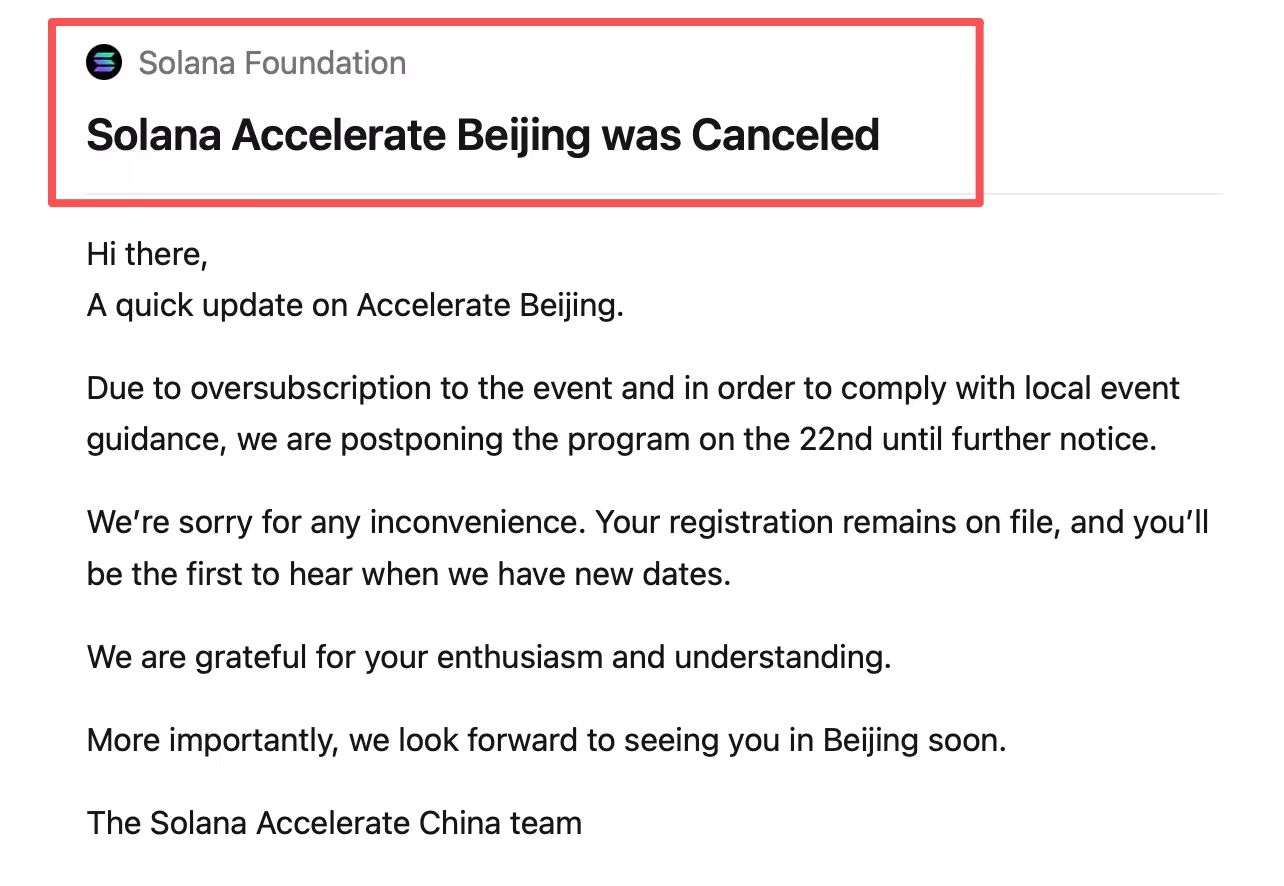
About an hour and a half later, the organisers sent an email citing “venue logistics” and notifying participants of a cancellation or postponement.
That evening, Solana Foundation president Lily Liu posted a more detailed explanation on X. As quoted in Chinese by the source and translated here: “Because of the publicity, registrations for the event quadrupled overnight, far exceeding the attendance limit we had notified to the local authorities, and we could not prevent people from entering the venue. To comply with local requirements, we will therefore postpone the event until we can better accommodate the scale of our community.”
Lily Liu’s original statement
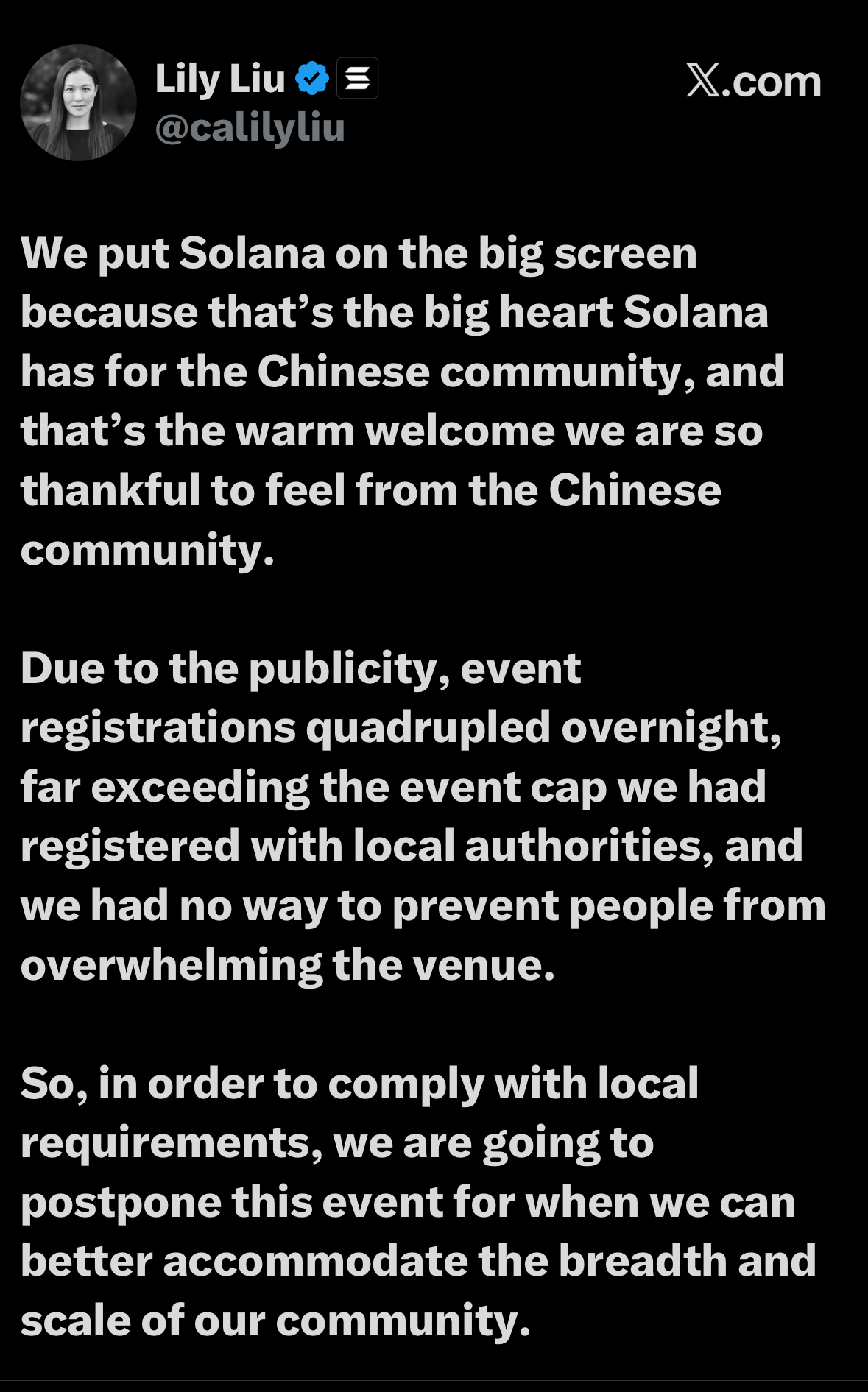
Lily Liu @calilyliu X.com We put Solana on the big screen because that’s the big heart Solana has for the Chinese community, and that’s the warm welcome we are so thankful to feel from the Chinese community. Due to the publicity, event registrations quadrupled overnight, far exceeding the event cap we had registered with local authorities, and we had no way to prevent people from overwhelming the venue. So, in order to comply with local requirements, we are going to postpone this event for when we can better accommodate the breadth and scale of our community.
No Chinese UI or Chinese main text is visible. The screenshot itself does not establish a publication timestamp.
Image: Lily Liu’s original statement on X. Source: X, @calilyliu.
The statement warrants attention both for what it answers and for what it leaves unanswered. It attributes the postponement to attendance exceeding capacity and to compliance requirements. The original article treats it as confirmation of a previously undisclosed notification arrangement between the organisers and local authorities. The statement does not, however, address attendees’ descriptions of law-enforcement personnel or identify the specific requirement meant by “comply with local requirements”. It does not use the words “police” or “regulatory intervention”.
2. The scale of the publicity three days earlier
To understand why the episode attracted attention, the source looks back three days.
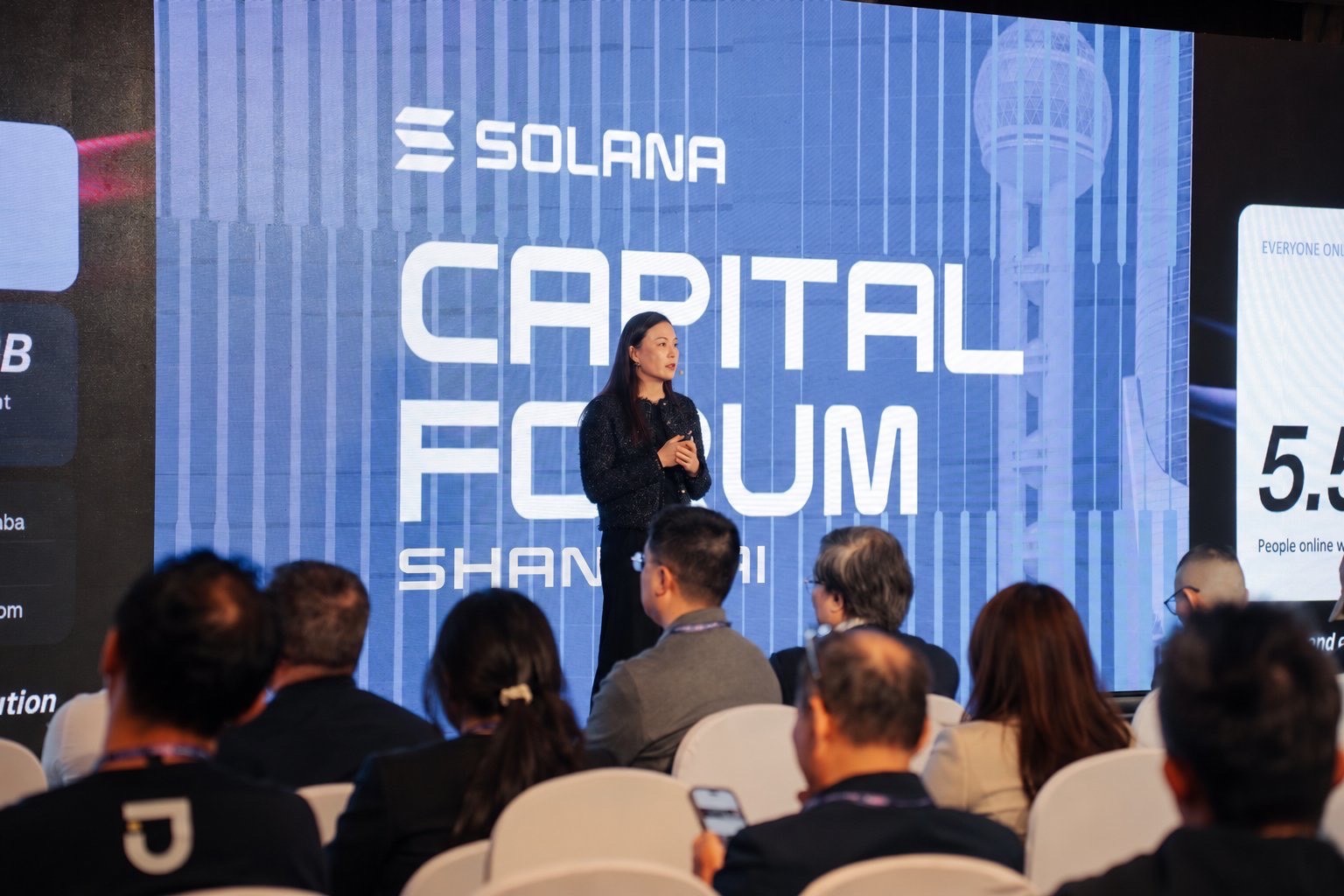
On the evening of 14 October, the facade of the Citi building in Lujiazui displayed a purple-and-blue SOLANA logo. Solana strategy executive Rachel Conlan posted about it on X. Around the same time, Solana executive Vibhu Norby showed a new office in Shanghai Tower, which foundation president Lily Liu reposted and confirmed.
Changpeng Zhao also reposted the material, saying, “BNB Chain has yet to achieve this”—an unusually positive assessment from him, in the author’s view.
Mainland authorities have long scrutinised the promotion of virtual currencies. The author sees the combination of waterfront illumination, an office in a prime business district and a four-city tour as an intensity of promotion unmatched by another overseas blockchain in recent years.
3. The two positions in the community
Community discussion after the announcement broadly divided into two camps.
Optimists argued that blockchain infrastructure, developer ecosystems, AI and hardware were matters of technology, distinct from token speculation.
The cautious camp’s judgement was that greater brand visibility made it easier to cross the boundary around the public promotion of virtual currencies.
In the author’s reading of the outcome on 16 October, the cautious camp had gained the early advantage. The enthusiasm generated by the illumination three days earlier dissipated much faster than expected.
4. Has the regulatory position changed?
The original article’s answer is no.
It states that Document No. 42, dated 6 February 2026 and issued by eight authorities including the central bank, continues to prohibit the business of exchanging fiat money and virtual currencies. It also says there was no official adjustment to that position before or after the event. These legal descriptions are retained as claims made by the source.
Two issues need to be distinguished. First, cancellation of an event and the regulatory framework are different matters: the former concerns the administrative handling of a particular gathering; the latter is a continuing policy framework. The halt of a single event does not, by itself, establish that policy has tightened. Second, Hong Kong’s licensing arrangements—which the source illustrates with what it calls OSL’s SOL retail licence—apply within Hong Kong’s jurisdiction, rather than to mainland business. The two cannot be treated as interchangeable.
5. What to track next
For people working in real-world assets and onchain businesses, this episode offers a basis for judging the pace of developments rather than drawing a final conclusion:
First, whether the Hangzhou event on 18 October, Shenzhen on 20 October and Beijing on 22 October would proceed as scheduled: the source identifies this as a particularly useful indicator. Second, the rescheduled date for Shanghai, and whether the foundation would clarify the meaning of “local requirements”. Third, whether the Alpenglow upgrade would be activated as planned on 21 October, at epoch 1064, with transaction finality reduced to approximately 150 milliseconds. That technical timetable, as described in the original article, is a separate matter from the arrangements for in-person events and offers an independent dimension to monitor.
Progress in a technical ecosystem and the compliance environment for in-person activity do not follow the same track. Combining them into a single judgement can lead to misleading conclusions.
Produced by RWA Space. The original article states that its factual claims should be assessed against publicly verifiable sources, that passages involving community speculation are identified, and that readers should not use it as a basis for decisions.
Professional English adaptation of the supplied commentary, whose stated information cut-off is the evening of 16 October 2026; that cut-off is not evidence of its original publication date. The source’s factual claims, translated quotations, legal descriptions, licensing references and upgrade timetable have not been independently verified in this adaptation. The wording distinguishes a postponement from a cancellation, and reported eyewitness accounts from the organisers’ explanation. The Lily Liu quotation is translated from the Chinese wording supplied in the article and is not presented as a newly retrieved English original. Complete adaptation for editorial review; not a new verification of the underlying account or investment advice. The publication date displayed separately was supplied by the site owner.